44 Boötis, also known as i Boötis, is a triple star system in the constellation Boötes. It is approximately 41.6 light years from Earth.
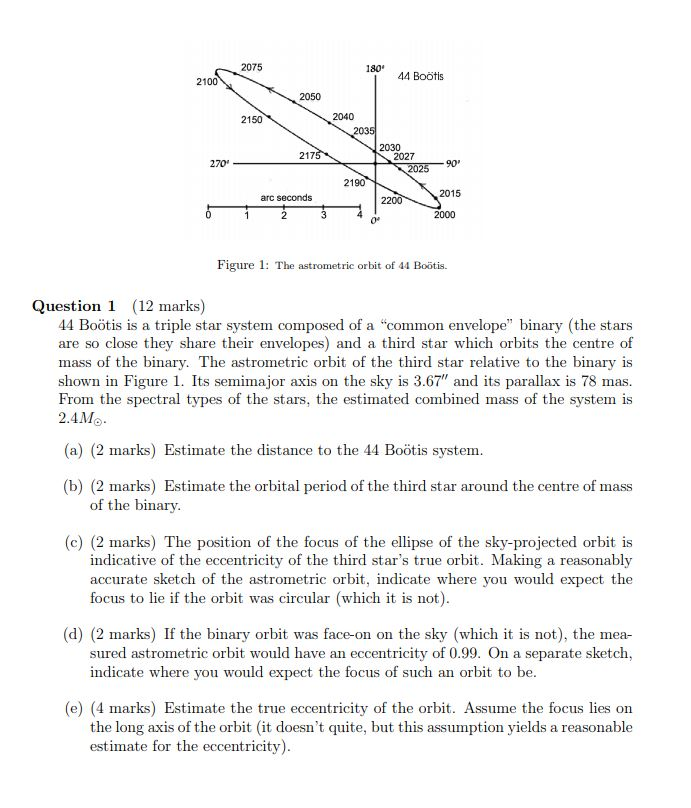
44 Boötis can be resolved into two stars, of 5th and 6th magnitudes respectively. They were separated by 1.5″ when the pair were confirmed in 1819, but were only 0.2″ by 2020 as the two orbit every 210 years.
The primary component, 44 Boötis A, also named Quadrans, is a yellow-white G-type main sequence star with a mean apparent magnitude of 4.83. The companion component, 44 Boötis B, is a W Ursae Majoris variable spectroscopic binary. The variability of this star system was discovered by English astronomer William Herschel. The brightness of the eclipsing binary varies from magnitude 5.8 to 6.40 with a period of 6.43 hours. The two eclipsing components of the system are close enough to allow their stellar envelopes to overlap, or at least nearly so. In 1948, flare behavior was measured from this system based on data from O. J. Eggen.
44 Boötis appears to have an infrared excess, implying the existence of a dust disk that absorbs visible light and re-emits it as infrared light. The dust would have a blackbody temperature of about 23 K, situated up to 182 au from the parent star.
This star was a member of the obsolete constellation Quadrans Muralis. The IAU Working Group on Star Names approved the name Quadrans for component A on 17 February 2025, after the obsolete constellation, and it is now so entered in the IAU Catalog of Star Names.
References
External links
- HR 5618
- Image 44 Boötis
- CCDM J15038 4739